Palestinian refugee camps are notorious for being narrow, congested, and dim. Yet the colors seem to emerge from drawings, nonetheless.
As Palestinians continued to be jaundiced by empty promises of return, the deafening silence of the world, and a conspired radio silence, the walls of refugee camps became what resembles modern-day social media today, serving as hubs for mobilizing people and sharing news.


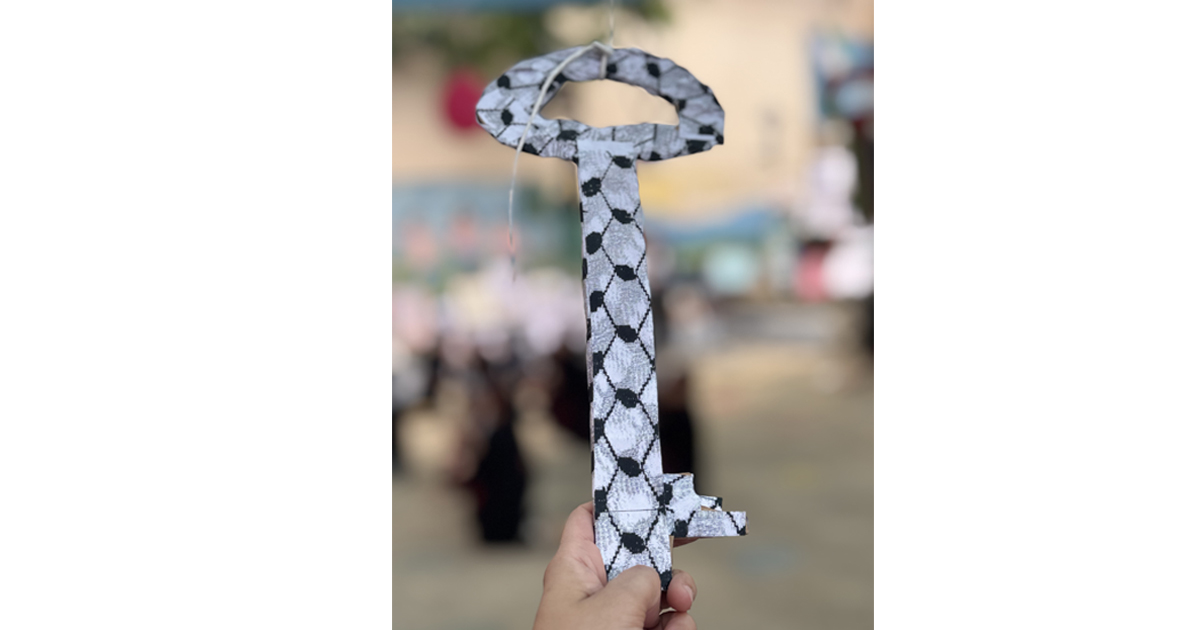
The Palestinian Graffiti art began years after the settlement of the refugee camps in the West Bank, to resist and express views. For instance, when the occupation prohibited the raising of the Palestinian flag, the Palestinian people went for the walls. Things like the big keys, the keffiyeh, the flag, the watermelon, and everything that symbolized the identity of Palestinians were drawn, fortifying their uprooting, and consolidating their persona.
“A wall is a very big weapon. It's one of the nastiest things you can hit someone with.”- Banksy.


In case you are still lost on why graffiti is considered a contemporary form of resistance, the Palestinians drew and continue drawing icons and messages promising their return, which in occupation habitualness they took simple art as a direct attack. The street art above is in the Burj Barajneh camp in Beirut. It shows a dad and his son wearing the keffiyeh holding the big key of their homes with the Palestinian flag on barbed wire and the Al-Aqsa Mosque. While the occupation has no occupancy in Lebanon, the Palestinian refugees draw them to morally support the cause. The union of the work involves reflection, style, and aesthetics.
Inside the Palestinian refugee camps in Lebanon, there’s no ceiling to what can be drawn. As a result, the faces of many political icons in the history of Palestine, political slogans, activists, and symbols, are seen all over the walls of refugee camps. It is evident how political figures and activists transcend death and their influence echoes for decades past them. While each fought for the liberation of Palestine in their own way their influence remains.


Quoting directly Banksy, he says graffiti is a tool because it becomes part of your city.
Habitants or frequent visitors of the Shatila refugee camp in Beirut know the above wall very well. In Shatila, there are over 10,000 registered refugees and with the Syrian war, the amount doubled. Subsequently, a wall like this serves a purpose in a densely populated one square kilometer surface area, it efficiently helps to point location.
As peaceful and creative the resistance through graffiti is, as impactful and dogmatized it is. With violence comes war, displacement, sickness, death, orphans, surgeries, trauma, amputations, hunger, thirst-the list is infinite, with it may come refrain and dissociation out of fear of living through another war. While graffiti and art in general evoke curiosity, the basis of enlightenment and knowledge, for Palestinians graffiti is also a tool for preserving their identity.

In this crazy world, the instinct to resist oppression is labeled as a firebrand act, borderline terrorism, but so was graffiti once. It went from vandalism to glorified art. And if graffiti can make that jump, so will the resistance.